September 2, 2026 · 7 min read
Building a Team Before the Business: A Lesson I Learned in 2000
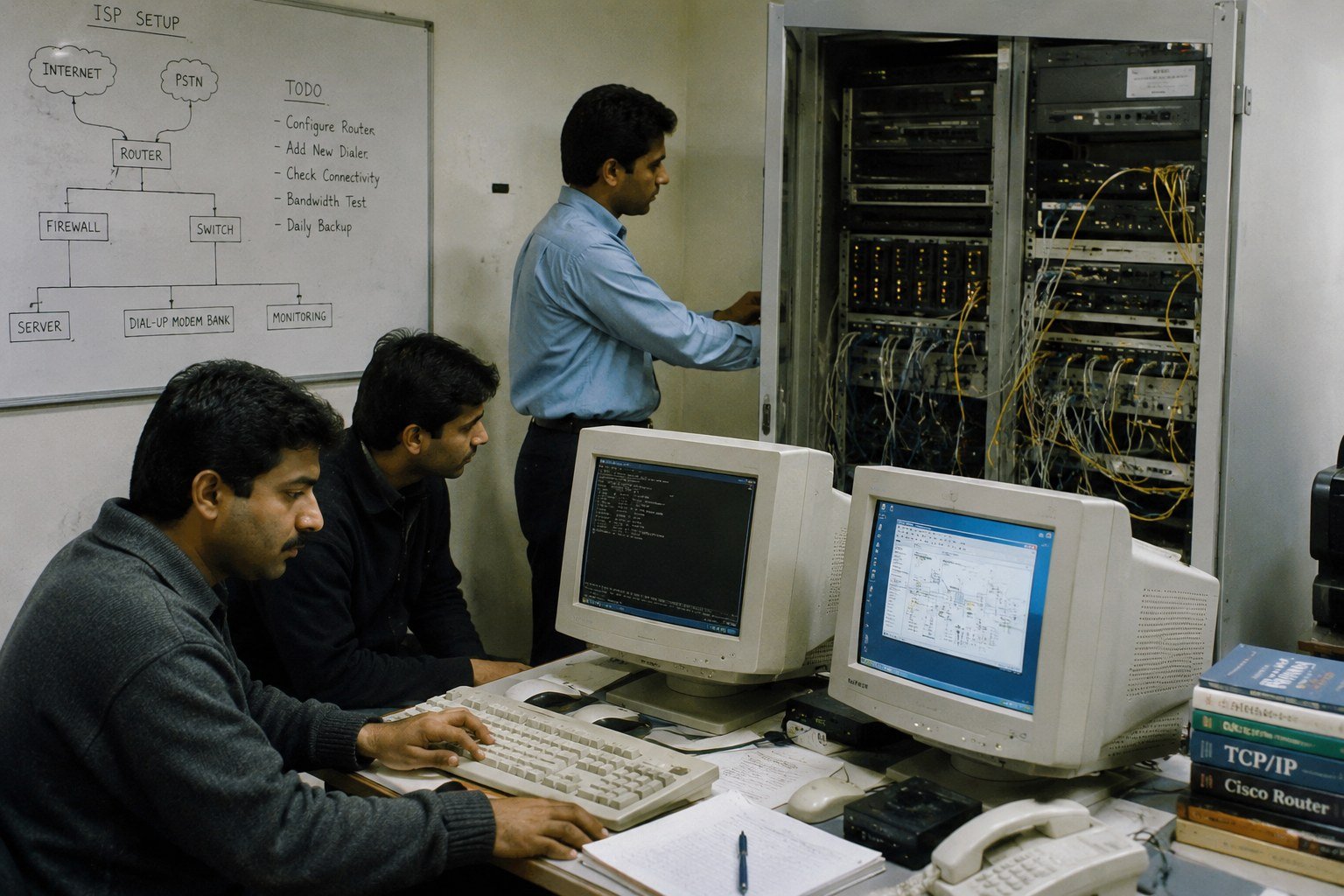
In 2000, a friend approached me with an idea.
He wanted to enter the technology business and asked me to help him explore the opportunity. At that time, I already had some technology experience and had qualified as an MCP and CCNA.
The opportunity was interesting.
Internet usage was beginning to grow rapidly in Pakistan, particularly among young people. But this was still the era of dial-up internet. There was no DSL, no fiber and certainly nothing like the internet infrastructure we take for granted today.
There was also no LinkedIn, Facebook or Instagram to help us find people or promote a new business.
I worked with another technical friend to prepare a feasibility study for a new Internet Service Provider. The proposal was approved by the investors, and we started working on the documentation required to obtain the ISP license from the Pakistan Telecommunication Authority.
But getting the license was only the beginning.
The Real Challenge Was Building the Team
We needed people for almost every part of the business: technical operations, sales and marketing, customer support, administration and finance.
The two areas that concerned us most were technical operations and sales.
Finding people with actual ISP experience was difficult. There simply weren't many people available with that background. Most of the technical candidates we could find had networking experience, but little or no experience actually running an ISP.
So we decided not to wait for the perfect team.
We first hired a seasoned technology professional who was already working for a large company and had strong experience in networking and related technology.
He became our key technical hire.
Then we built a team around him.
We hired two people who had some networking and ISP experience and three fresh Computer Science graduates from leading Pakistani universities.
That combination turned out to be very important.
Hiring Was Only Half the Job
One thing I learned from that experience is that bringing people through the door doesn't mean they are ready to do the job.
We knew some members of our technical team had never worked in an ISP environment.
So, before the actual launch, we ran an intensive training program for roughly one to one-and-a-half months.
But this wasn't training in a classroom followed by a start date.
The team was learning while helping to build the Technical Center.
They worked through everything from networking setup and router configuration to servers, troubleshooting, customer connectivity and monitoring.
They were learning the theory, but at the same time they were putting it into practice.
By the time we were ready to launch, the team had gone from having limited ISP-specific experience to being capable of operating the Technical Center.
That experience has stayed with me.
Sometimes hiring the right people means hiring people who can become right for the job — not only people who already know everything.
Sales Required a Different Approach
We didn't necessarily need people who had already sold internet services. Good salespeople understand how to sell.
At that time, the closest comparable industry was the payphone business, so we recruited people with that kind of sales experience.
But we still had to train them.
Our service was primarily sold through prepaid cards, with denominations ranging from Rs. 10 to Rs. 500.
We gave the sales team a very simple objective:
Reach every shopkeeper in Rawalpindi and Islamabad who sells soft drinks and make our cards available there.
It sounds simple today, but remember the environment in 2000.
There were no social media campaigns. No digital advertising. No online marketplaces.
We had posters, flyers, banners and people going from shop to shop.
We also introduced incentives — including bonuses for high-performing salespeople and gifts for our best retailers.
At first, it was hard.
But gradually, things started moving.
As customers experienced the quality of our internet service, demand for the prepaid cards increased. Our retailer network grew, and the sales operation gained momentum.
The Result
The ISP launched successfully.
Within one year, we became the No. 2 ISP in Rawalpindi/Islamabad.
We didn't become No. 1.
At that time, the market leader was a much larger player with substantially more PRI capacity and infrastructure than we had.
But reaching No. 2 within our first year was a significant achievement for a new entrant.
And I believe the reason was not one particular decision.
It was the combination of several things:
The right leader. The right mix of people. Proper training. The right resources. And, most importantly, we focused on delivering a quality service.
What This Taught Me About Building Teams
Looking back more than 25 years later, the technology has changed completely.
The hiring tools have changed. The way companies communicate has changed. The way businesses reach customers has changed.
Today, a founder can advertise a job on LinkedIn and receive hundreds of applications in days. A team can work remotely from different countries. Training can happen online. AI can help screen candidates and build processes.
But one thing hasn't changed.
A business still depends on the quality of the team behind it.
And I think founders sometimes put too much emphasis on finding the perfect candidate.
In my experience, building a good team is often more complicated — and more interesting — than that.
You may need one experienced person who can provide direction.
You may need younger people who have the ability and willingness to learn.
You may need to train people before they are fully ready.
And you may need to build the systems around them that allow them to succeed.
That was true in 2000.
I believe it is still true today.
For a founder in the US or UK considering building a team in Pakistan, the lesson I would take from my experience is simple:
Don't just ask, “Who can I hire?”
Ask:
“What team do I need to build, and how will I develop that team to become capable of running the business?”
That is a very different question.
And often, it leads to a much better answer.

Keep Reading
The Org Chart Mistake Founders Make With Their First Offshore Hire
Founders get the person right more often than you'd think. It's the org chart that goes wrong, and it's the mistake that quietly turns a promising first Pakistan hire into a management headache.
Cost Was Never the Problem: What Actually Breaks an Offshore Team
Founders build offshore teams for the cost savings. After 25 years running HR and operations teams, cost never told me whether one would work. Structure did.