September 22, 2026 · 5 min read
The Org Chart Mistake Founders Make With Their First Offshore Hire
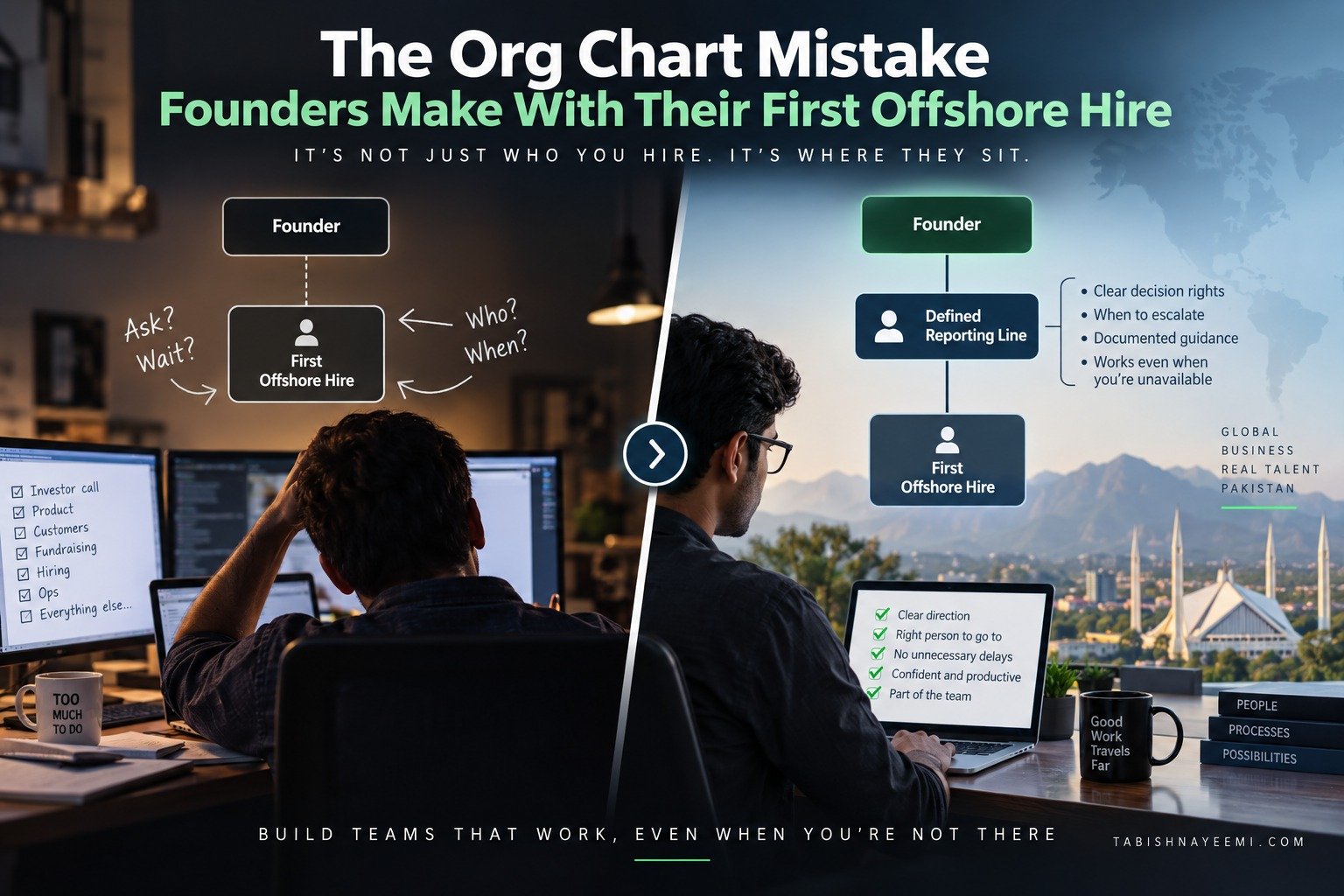
Founders get the person right more often than you'd think. It's the org chart that goes wrong.
Almost every conversation about a first Pakistan hire is about the candidate. Skills, English, timezone overlap, rate. Almost none of it is about where that person actually sits in the business once they start.
The Default Answer Is Always the Same
Ask a founder who their first offshore hire reports to, and the answer is almost always "me." That sounds like accountability. In practice it's often the opposite.
"Reports to me," from a founder juggling ten other things, usually means the hire's real reporting line is whoever happens to be free that day. Some weeks that's the founder, fully present, answering questions within the hour. Other weeks it's nobody, because the founder is in back-to-back calls or asleep on the other side of the clock, and the hire is left guessing whether to wait or move.
"Reports to Me" Is Not a Structure
A reporting line only does its job if it answers two questions: who to bring a decision to, and how long to wait before escalating it. "Reports to me" answers the first question some of the time, and the second almost never.
In every team I've built or fixed over the past 25 years, this problem showed up in the same shape. It wasn't that the first hire lacked direction on day one. It was that the direction only existed when the founder had time to give it. The org chart said one thing. The actual working pattern said something else entirely.
The Question That Actually Matters
The real test of a first hire's place in the org chart isn't what happens when the founder is available. It's what happens when they're not, on a flight, asleep, mid-fundraise, buried in a different fire entirely.
If the honest answer is "they wait," the structure has already failed, even if it looks fine on paper.
What a Working First Hire Actually Looks Like
None of this requires a big team or a formal manager. It requires deciding, before the first hire starts, who actually holds the reporting line on the days the founder can't.
That can be as simple as a defined threshold for what needs the founder immediately versus what waits for the next sync, and a habit of writing decisions down so the same question doesn't resurface every week. It's less about hierarchy and more about making sure a decision has somewhere to go, even on the days the founder is unreachable.
If you're weighing your first Pakistan hire and want a second opinion on how to structure it before you make the offer, I'm happy to talk it through, no obligation, just a straightforward conversation.

Keep Reading
Cost Was Never the Problem: What Actually Breaks an Offshore Team
Founders build offshore teams for the cost savings. After 25 years running HR and operations teams, cost never told me whether one would work. Structure did.
Pakistan's Positioning Problem: Why It Rarely Makes the Hiring Shortlist
Pakistan has the talent to compete with any offshore market. So why does it rarely make the shortlist? A positioning problem, not a talent one.